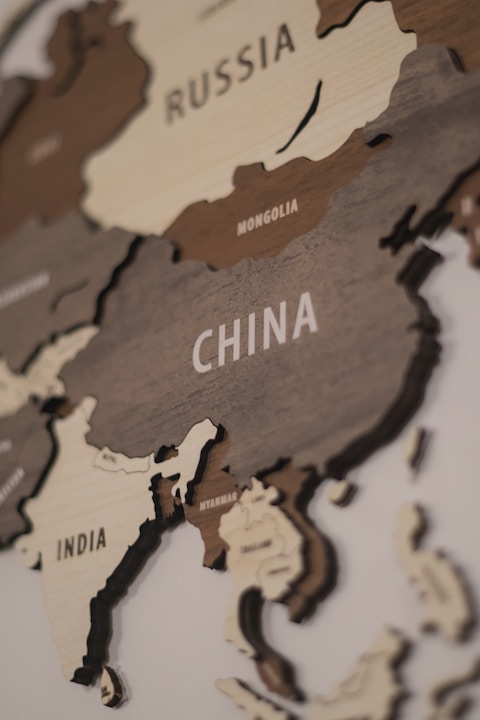
Navigating Economic Interdependence and Political Friction Between Asia’s Giants
The complex relationship between India and China represents one of Asia’s most significant geopolitical dynamics, characterized by deep economic interdependence alongside persistent political and border tensions. This article explores how trade relations between the world’s two most populous nations have evolved despite ongoing diplomatic challenges and military standoffs that periodically threaten to disrupt their economic partnership.
The historical foundations of India-China trade are ancient and robust, predating modern political friction. For centuries, the Silk Road served as a vital artery, facilitating the exchange of Indian spices, textiles, and precious stones for Chinese silk and porcelain. This established a deep-seated economic interdependence. The colonial era, however, reconfigured these patterns, integrating both economies into British imperial trade networks, often to their mutual detriment. Following independence in 1947 and the establishment of the People’s Republic of China in 1949, the slogan Hindi-Chini Bhai-Bhai (Indians and Chinese are brothers) briefly fostered warm relations and modest trade, primarily in commodities like Indian jute and Chinese machinery. This fragile camaraderie was shattered by the 1962 border war. The conflict had an immediate and chilling effect, causing trade to plummet to near-zero levels for over a decade. The political estrangement was absolute, severing the economic and cultural links that had been carefully rebuilt. It was not until the late 1970s, with China’s economic reforms, that border trade tentatively resumed, setting a cautious precedent for the more significant re-engagement that would define the 1990s and beyond.
Since the early 2000s, India-China trade has expanded at a breathtaking pace, transforming a negligible economic relationship into a complex interdependence. Bilateral trade surged from under $3 billion in 2000 to exceed $100 billion by 2021, with China solidifying its position as India’s largest trading partner. This growth was fueled by key sectors: Chinese exports to India are dominated by manufactured goods, including critical machinery, telecommunications equipment, and consumer electronics that feed India’s domestic markets and infrastructure projects. In stark contrast, Indian exports have remained largely concentrated in raw materials like iron ore and cotton, alongside a significant but smaller stream of pharmaceutical products and marine goods. This lopsided trade composition has created a persistent and growing trade deficit for India, which ballooned to over $70 billion, becoming a major point of political friction. Both governments have attempted to navigate this tension through economic dialogues and discussions on new trade agreements, striving to balance the undeniable economic benefits with escalating strategic distrust and the need to protect domestic industries from a flood of Chinese imports.
The 2020 Galwan Valley clash marked a critical inflection point, transforming India’s economic engagement with China from cautious interdependence to strategic recalibration. This deadly military confrontation directly challenged the long-standing assumption that economic ties could remain insulated from geopolitical friction. In response, India implemented a multi-pronged policy aimed at reducing strategic vulnerabilities. A significant push for border infrastructure development was accelerated to bolster logistical and military responsiveness along the Line of Actual Control. Economically, New Delhi enforced investment restrictions on Chinese firms, mandating government approval for foreign direct investment from bordering countries, which severely curtailed Chinese capital inflow. Simultaneously, India instituted bans on hundreds of Chinese mobile applications, including popular platforms like TikTok and WeChat, citing data security and national sovereignty concerns. These measures have begun to reshape bilateral trade patterns, not through a full-scale decoupling, but by fostering a calculated strategic autonomy. While merchandise trade, particularly imports of Chinese manufactured goods and critical inputs, remains high, these policies signal a deliberate and sustained effort to diversify supply chains and build domestic capacity, thereby altering the very structure of the economic relationship.
The pharmaceutical sector reveals India’s critical dependency on Chinese active pharmaceutical ingredients (APIs), with over 60-70% of its bulk drug requirements sourced from China. This creates a significant supply chain vulnerability, where any disruption directly threatens India’s generic drug manufacturing, a global powerhouse. In electronics, the reliance is even more pronounced; most consumer electronics and smartphone assembly in India depend heavily on Chinese components, from printed circuit boards to semiconductors. The telecommunications sector, particularly with the exclusion of Huawei from India’s 5G trials, illustrates the political friction directly impacting trade, pushing Indian operators to seek costlier alternatives. Conversely, the Indian automotive and burgeoning renewable energy sectors, especially solar module manufacturing, are tethered to Chinese raw materials and equipment. While Indian government initiatives like the Production Linked Incentive (PLI) scheme aim to foster domestic capacity and reduce this dependency, Chinese companies simultaneously face market access challenges in India, losing a massive consumer base for their finished goods and investment projects, creating a complex web of economic interdependence strained by political rivalry.
Looking ahead, India-China trade faces several potential trajectories, all colored by persistent geopolitical friction. One scenario involves a managed decoupling, where strategic sectors see reduced interdependence while non-sensitive trade continues, albeit under heightened scrutiny. Conversely, a competitive coexistence model might emerge, where both giants continue trading out of pure economic necessity while actively building parallel economic blocs to minimize mutual reliance. This diversification is already evident. India is aggressively pursuing trade agreements with the EU and engaging more deeply with partners via the Quad, while China solidifies its position through the RCEP, from which India abstained.
The role of multilateral platforms is becoming a central arena for this maneuvering. Within BRICS and the SCO, both nations perform a delicate dance, cooperating on a shared multipolar world vision while competing for influence within these very groups. These forums offer a conduit for dialogue but also amplify their underlying rivalry. Technological competition and infrastructure diplomacy, like India’s participation in the U.S.-led Partnership for Global Infrastructure and Investment versus China’s Belt and Road Initiative, are creating competing supply chain ecosystems. This bifurcation threatens to fragment regional economic integration, forcing smaller Asian nations to choose sides and potentially creating two distinct, overlapping economic spheres in Asia dominated by New Delhi and Beijing.
Conclusions
The India-China trade relationship remains a complex interplay of economic necessity and strategic competition. While both nations recognize the mutual benefits of trade, geopolitical tensions and border disputes continue to shape economic policies. The future likely holds a more cautious, regulated trade partnership as India seeks to reduce dependencies while China aims to maintain market access, creating a delicate balance between cooperation and competition in Asia’s evolving economic landscape.
hi