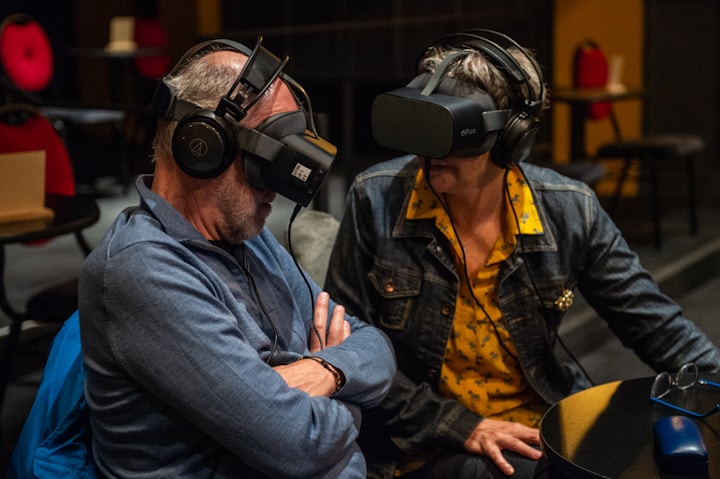
Exploring the convergence of augmented reality and artificial intelligence in the international competition for technological dominance
The convergence of augmented reality and artificial intelligence is accelerating a global technological race that will redefine economic and military power. Nations and corporations are investing billions to lead in these transformative technologies. This article examines how AR and AI integration is creating new frontiers in innovation while reshaping international competition dynamics across multiple sectors.
At its core, augmented reality functions by using cameras and sensors to understand the physical environment. Through a process called simultaneous localization and mapping (SLAM), AR devices create a 3D map of the surroundings in real-time. This digital model allows virtual objects to be anchored precisely within the physical world, appearing on screens from smartphones to specialized smart glasses. The illusion is complete when these computer-generated graphics are composited seamlessly with the user’s live view.
Concurrently, artificial intelligence provides the cognitive engine. Machine learning algorithms enable systems to learn from data and improve over time without explicit programming for every scenario. A critical subset, computer vision, allows machines to identify and classify objects within images and video streams, which is fundamental for AR’s environmental understanding. Natural language processing (NLP) empowers systems to comprehend and respond to human speech and text.
The true power emerges from their convergence. AI’s computer vision dramatically enhances AR’s spatial awareness, enabling it to not just map a room but recognize a specific chair or tool. In industrial maintenance, an AR headset powered by AI can overlay repair instructions directly onto the faulty component it identifies, guided by NLP for voice commands. This synergy transforms passive information display into an interactive, intelligent partnership with the digital world.
At the core of the AR revolution lies its powerful synergy with artificial intelligence. While AR provides the digital canvas, AI acts as its intelligent engine, transforming simple overlays into context-aware, interactive experiences. This fusion is primarily driven by AI-powered computer vision, which enables real-time object recognition and precise spatial mapping. By analyzing a device’s camera feed, machine learning models can identify surfaces, measure dimensions, and anchor digital content persistently into the user’s physical environment.
This intelligence extends to personalization, where algorithms analyze user behavior to tailor AR content, creating adaptive interfaces that anticipate needs. Specific integrations showcase this powerful combination. Real-time language translation in AR displays, like Google Lens, uses AI for on-the-fly text recognition and conversion. Intelligent object tracking, fundamental to applications like IKEA Place, relies on convolutional neural networks to understand and lock onto items in a 3D space. These systems typically operate on a hybrid technological architecture, leveraging on-device processing for low-latency responses while utilizing cloud-based AI for complex computational tasks, ensuring a seamless and deeply integrated user experience that is central to the global tech race.
The global investment landscape reveals stark contrasts in how major powers are approaching the AR and AI race. The United States leads with a market-driven model, where private sector giants like Google and Meta invest tens of billions annually, complemented by federal initiatives like the National AI Initiative. In stark contrast, China’s approach is state-directed, with its New Generation Artificial Intelligence Development Plan mobilizing massive public and private capital, aiming for global AI leadership by 2030. The European Union is forging a distinct path focused on ethical frameworks and collaborative research, channeling over €10 billion through its Digital Europe Programme while proposing the world’s first comprehensive AI Act to regulate high-risk applications.
Key regional strategies include:
* US: Heavy reliance on venture capital and defense contracts, with DARPA funding foundational research.
* China: National champions like Baidu and massive state-backed investment in smart cities and AR infrastructure.
* EU: A regulatory-first stance, prioritizing data governance and talent mobility across member states to build a unified digital market.
These divergent funding models and policy frameworks are creating fundamentally different innovation ecosystems, directly influencing the pace and ethical boundaries of technological development worldwide.
The fusion of AR and AI is fundamentally altering military doctrines, moving beyond theoretical applications to active deployment. For battlefield visualization, systems like the U.S. Army’s Integrated Visual Augmentation System (IVAS) use AI to overlay real-time data, friendly and enemy positions, and mission objectives directly onto a soldier’s visor, creating a shared operational picture. This AI-enhanced AR drastically reduces the fog of war. In training, immersive simulations generate dynamic, intelligent adversaries and complex scenarios, allowing units to rehearse missions with unprecedented realism. Maintenance is revolutionized as AI-driven AR glasses guide technicians through complex repairs by superimposing schematics and step-by-step instructions onto physical equipment, slashing downtime. Command and control centers leverage these systems for enhanced situational awareness, with AI synthesizing intelligence from drones and satellites into actionable AR overlays for commanders. Nations are racing to secure this advantage; China’s research into AI for augmented command posts and Russia’s development of similar systems for armored vehicles highlight a global shift. The strategic implication is a new form of warfare where information dominance, delivered through seamless human-machine teaming, becomes the ultimate tactical edge.
The geopolitical implications of AR-AI convergence are reshaping global economic hierarchies. Nations leading this technological revolution are positioning themselves to dominate next-generation supply chains and establish new international standards. This leadership translates directly into economic leverage, influencing everything from manufacturing to financial services. The transformation of labor markets is particularly profound, as automation through intelligent AR systems displaces routine jobs while simultaneously creating demand for highly specialized roles in digital twin management and immersive interface design. This shift risks exacerbating global inequality, potentially creating a technological caste system where nations without advanced digital infrastructure become permanently disadvantaged.
Societally, the erosion of privacy reaches unprecedented scales as these technologies enable continuous environmental monitoring and behavioral analysis. The digital divide evolves into an experiential divide, separating those who can enhance their reality from those confined to physical limitations. Ethical frameworks struggle to keep pace with capabilities like emotion recognition through AR wearables or AI-driven reality manipulation. Regulatory approaches are becoming strategic tools themselves, with restrictive measures potentially stifling innovation while lax policies risk societal harm. This regulatory divergence may ultimately determine which technological ecosystems achieve global dominance, fundamentally altering international relations and development trajectories for decades to come.
Conclusions
The fusion of augmented reality and artificial intelligence represents a pivotal technological frontier in the global competition for innovation leadership. Nations that successfully harness these converging technologies will likely dominate future economic and security landscapes. However, this race demands careful consideration of ethical frameworks and international cooperation to ensure technological advancement benefits humanity broadly while maintaining global stability and security.
hello
hey
d